TV-Over-Fireplace Installations: Safety and Design Tips
Mounting a TV above a fireplace in the GTA? Learn safe heat clearances, venting, and design tips for gas units across Toronto and Ontario homes.
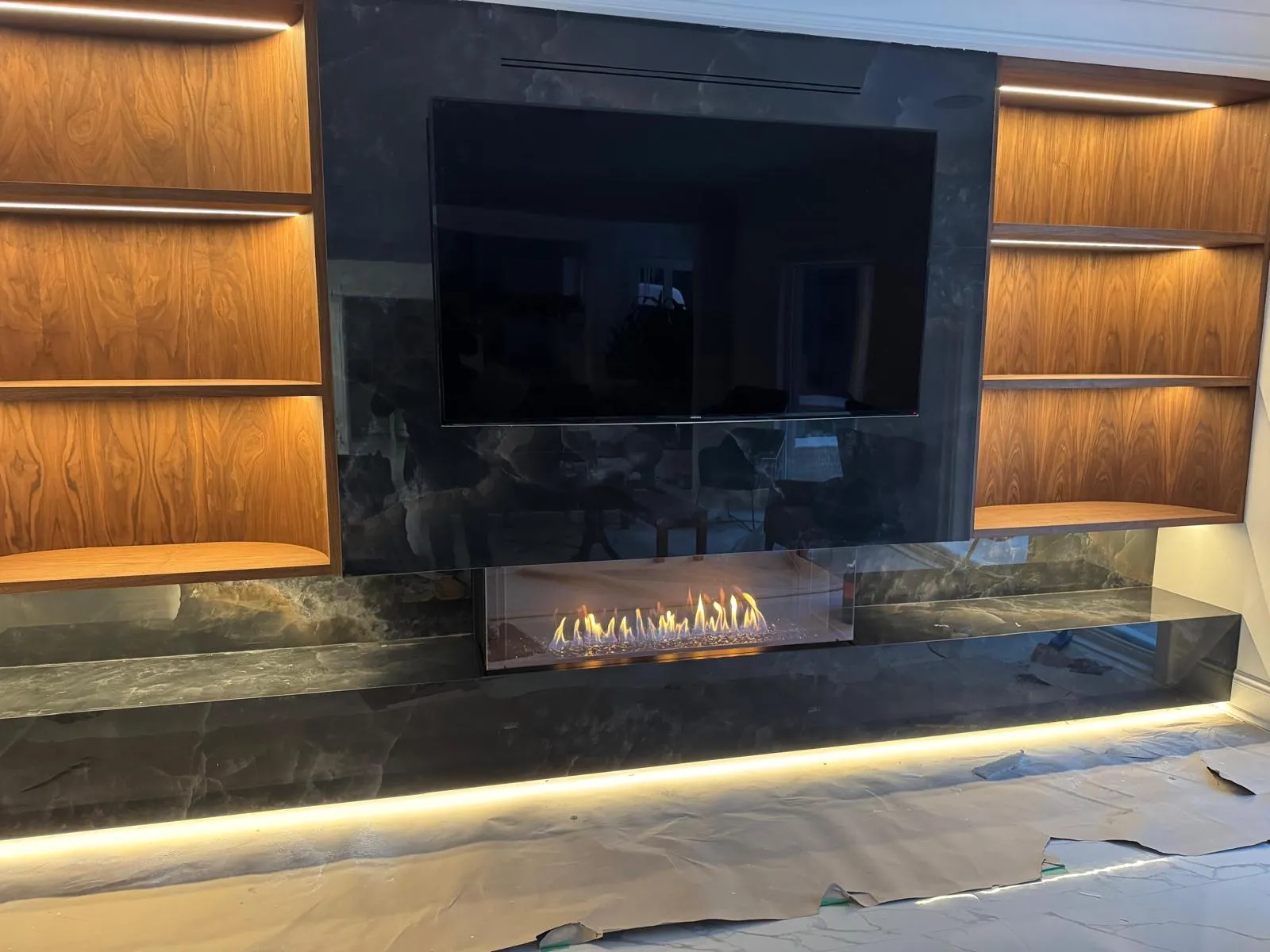
A TV mounted above a fireplace is one of the most-requested looks in GTA living rooms — clean sightlines, a single feature wall, and a furniture layout that finally makes sense. It is also one of the easiest ways to fry a $2,000 television, scorch drywall, or void a fireplace warranty if the install is done by feel instead of by the book.
The good news: with a modern direct-vent gas fireplace, a proper heat shield, and a few millimetres of planning, the combination works beautifully and lasts. Here is how Delson Air thinks about these installs across Toronto, Mississauga, Vaughan, Markham, and the rest of the GTA.
The short version: TVs and fireplaces can share a wall, but only with the right unit, clearances, and venting. Start with a sealed direct-vent or linear gas fireplace, follow the manufacturer’s listed clearances to combustibles, and add a heat-deflecting mantel or shield. For older B-vent or wood units, plan on a much bigger offset — or move the TV.
Why the TV-over-fireplace question is really a heat question
Every TV has a maximum ambient operating temperature — usually around 35-40 degrees Celsius at the back of the panel. Above that, LCD layers can delaminate, capacitors age fast, and HDMI boards throw intermittent errors. Warranty fine print almost always excludes heat damage.
A gas fireplace can easily push the wall surface above the opening past 60 degrees Celsius if there is no shield, no mantel, and no offset. That is the entire problem in one sentence.
Pick the right fireplace first, then the TV
Not every fireplace is TV-friendly. The unit type controls how heat leaves the firebox and where it ends up.
| Fireplace type | TV above? | Why |
|---|---|---|
| Direct-vent linear gas | Usually yes | Sealed combustion, side/front heat throw, optional cool-wall and power-vent kits |
| Direct-vent traditional gas | Often yes, with shield | Sealed, but more upward radiant heat — needs mantel + offset |
| B-vent / natural-vent gas | Generally no | Open flue, lots of rising heat right under the TV |
| Wood-burning (masonry or insert) | Not recommended | High radiant + convective heat, soot, and creosote on the wall |
| Electric fireplace | Yes, easily | Heat is forced out the front grille only; wall stays cool |
If you are still choosing a unit, our guides on how to choose a gas fireplace and linear vs traditional gas fireplaces walk through the trade-offs. For a brand-new install where the TV is non-negotiable, a direct-vent linear is almost always the right answer.
Heat shielding: the detail that makes or breaks the install
A heat shield is any non-combustible barrier that deflects rising heat away from the wall surface above the firebox. In a TV-over-fireplace setup, it does three things at once: it protects the drywall, it diverts heat outward into the room, and it keeps the TV inside its temperature envelope.
Common approaches:
- A deep mantel (often 10-15 cm / 4-6 in projection) above the firebox, throwing heat forward.
- A manufacturer-supplied cool-wall kit for the specific fireplace model.
- A non-combustible surround (stone, porcelain tile on cement board, steel) extending up to the TV.
- A power-vent / heat dump option that ducts excess heat to another room.
Important: A mantel is not decoration on a TV install — it is part of the safety system. Skipping it, or mounting the TV behind a thin floating shelf, is the most common mistake we see on retrofits across the GTA.
Venting is non-negotiable
Every gas appliance in Ontario has to be vented in line with CSA B149.1 and the manufacturer’s instructions. With a direct-vent unit, combustion air comes in and exhaust goes out through a sealed coaxial pipe, usually horizontally through an exterior wall. That is what makes the appliance safe to seal into a finished wall under a TV.
Things we check on every TV-over-fireplace job:
- Vent termination clearances — distance from windows, soffits, decks, and neighbouring walls per code.
- Vent path length and elbows — within the unit’s tested venting tables.
- Combustion air supply — no blockage, no shared chase with low-voltage cabling.
- Carbon monoxide alarms — present on every storey with a fuel-burning appliance, per Ontario regulation.
If a contractor cannot show you the manufacturer’s vent table for your specific unit, that is a red flag. As TSSA-licensed and Enbridge Authorized installers, we plan venting before drywall ever goes up.
Mounting height and viewing angle
Even when the heat math works, the ergonomics often do not. A TV mounted too high turns movie night into a chiropractor’s bill.
Rules of thumb:
- Centre of the screen should sit roughly at eye level when seated — typically 100-120 cm (40-48 in) off the finished floor.
- For TV-over-fireplace setups, a tilting or pull-down mount brings the screen toward the viewer and lowers the effective angle.
- Sofa-to-screen distance for a 65-inch 4K TV is roughly 2.4-3.0 m (8-10 ft).
If the only way to make the heights work is to push the TV up near the ceiling, the right answer is usually a shorter, linear fireplace lower on the wall — or the TV on an adjacent wall.
Cabling, outlets, and the recessed media box
Plan the rough-in before drywall:
- One recessed power outlet behind the TV (with a low-voltage box beside it for HDMI/Ethernet).
- One recessed outlet at the fireplace for the unit’s igniter and any blower kit.
- In-wall rated (CL2/CL3) HDMI runs to the AV cabinet or shelf below.
- A dedicated stud bay for cabling, separated from the vent chase.
Never run anything inside the fireplace chase itself. Heat, vibration, and code all agree on that.
A quick safety checklist before you commit
- Manufacturer’s manual confirms TV mounting above is permitted with stated clearances.
- Mantel, heat shield, or cool-wall kit specified and in the drawings.
- Direct-vent (or sealed) appliance, vented through an exterior wall.
- CO alarm on the same level as the fireplace.
- TV ambient temperature rating reviewed against expected wall temperatures.
- Recessed power and low-voltage boxes roughed in before drywall.
- Permit pulled where required by your municipality.
You can see examples of finished installs across the GTA in our gallery, and the full scope of what we do on the services page.
When to call Delson Air
If you are planning a renovation, a new build, or a tricky retrofit where the TV has to live above the fireplace, talk to us before the drywall goes up. Delson Air is a licensed, insured, TSSA-licensed contractor and an Enbridge Authorized dealer serving the Greater Toronto Area — Toronto, Mississauga, Markham, Vaughan, Brampton, Richmond Hill, Oakville, and surrounding. We will size the right direct-vent fireplace, design the heat shielding, plan the venting and cabling, and hand the finished wall to your TV installer ready to go.
Call us at (647) 467-9919 or reach out through /contact/ — your comfort, our priority.
FAQ
Common questions
Will mounting a TV above my gas fireplace damage it?
How far above the fireplace opening should the TV sit?
Can I run TV and HDMI cables behind the fireplace wall?
Is a linear gas fireplace better than a traditional one for a TV setup?
Delson Air Team
Licensed, insured, TSSA-certified HVAC technicians serving the Greater Toronto Area.
Keep reading
More from the Journal
Why Furnaces Fail in October: GTA Pre-Winter Warning Signs
October is when GTA furnaces fail most. Learn the pre-winter warning signs Toronto and Mississauga homeowners should catch before the first hard freeze.

Carbon Monoxide Safety: Why GTA Homes Need an Annual Furnace Check
Carbon monoxide is invisible, odourless, and produced by every gas furnace in the GTA. Here's how an annual furnace check keeps your Toronto-area home safe.

Hydronic Heating: Is It Right for Your Older GTA Home?
Is hydronic heating right for an older Toronto or GTA home? Compare radiator retrofits, in-floor retrofits, condensing boilers, costs, and Ontario climate fit.