Indoor Air Quality During Wildfire Smoke Season in Ontario
When wildfire smoke drifts over the GTA and Ontario, here's how to keep indoor air clean — HEPA, MERV 13+ filtration, sealing leaks, and running your HVAC the right way.
Wildfire smoke used to feel like a distant Western problem. Over the last few summers, GTA homeowners have learned otherwise — when the wind shifts and smoke from northern Ontario, Quebec, or the Prairies drifts south, the Toronto skyline turns orange and the air quality index climbs into the red. Doors stay shut. Schools cancel outdoor recess. And the air inside your home suddenly matters a lot more than the weather forecast.
The good news is that a well-set-up house, with the right filtration and a few sealing habits, can stay noticeably cleaner than the outdoor air during a smoke event. The bad news is that most homes aren’t set up that way by default.
The short version: During wildfire smoke season, keep windows closed, run your central air conditioning on recirculate with a MERV 13+ filter, and add a portable HEPA unit in your main living area. Seal obvious leaks, change furnace filters more often than usual, and watch outdoor AQHI before opening up. Want help getting your system smoke-ready? Get in touch.
Why wildfire smoke is harder on indoor air than regular pollution
Wildfire smoke isn’t just an odour — it’s a soup of fine and ultrafine particles, the worst of which is PM2.5: particulate matter smaller than 2.5 microns. That size matters because PM2.5 slips deep into your lungs and bloodstream. Health Canada’s Air Quality Health Index (AQHI) reflects this, and during recent Ontario smoke days the index has pushed past 10 in the GTA.
Smoke particles are also small enough to leak through the same gaps that let your conditioned air escape: window frames, attic hatches, recessed lights, dryer vents, mail slots, and the joints around your basement rim joist. So the same envelope problems that drive up your heating and cooling bills are also what let smoke into your home.
Start with the building envelope: seal the house
Filtration only works on air that’s already inside the house. The first job during a smoke event is to limit how much smoky outdoor air gets in to begin with.
- Close all windows and exterior doors. Use the deadbolt — it pulls the door tighter against the weatherstripping.
- Shut and lock windows you don’t normally use; locks pull the sash into the seal.
- Close the HRV/ERV fresh-air intake if your home has one. Check your controller — many have a “recirculate” or “smoke” mode.
- Close fireplace dampers, including gas fireplace flues if practical.
- Avoid running range hoods and bathroom fans longer than you need to; they pull replacement air in through every leak in the house.
- Throw a damp towel along the bottom of leaky doors as a temporary gasket.
A note on safety: never seal up a home so tightly that you compromise combustion appliance venting. If you have a non-sealed gas furnace, water heater, or fireplace, keep an eye on carbon monoxide alarms and don’t block intake vents. When in doubt, call us.
Upgrade your furnace filter to MERV 13 or better
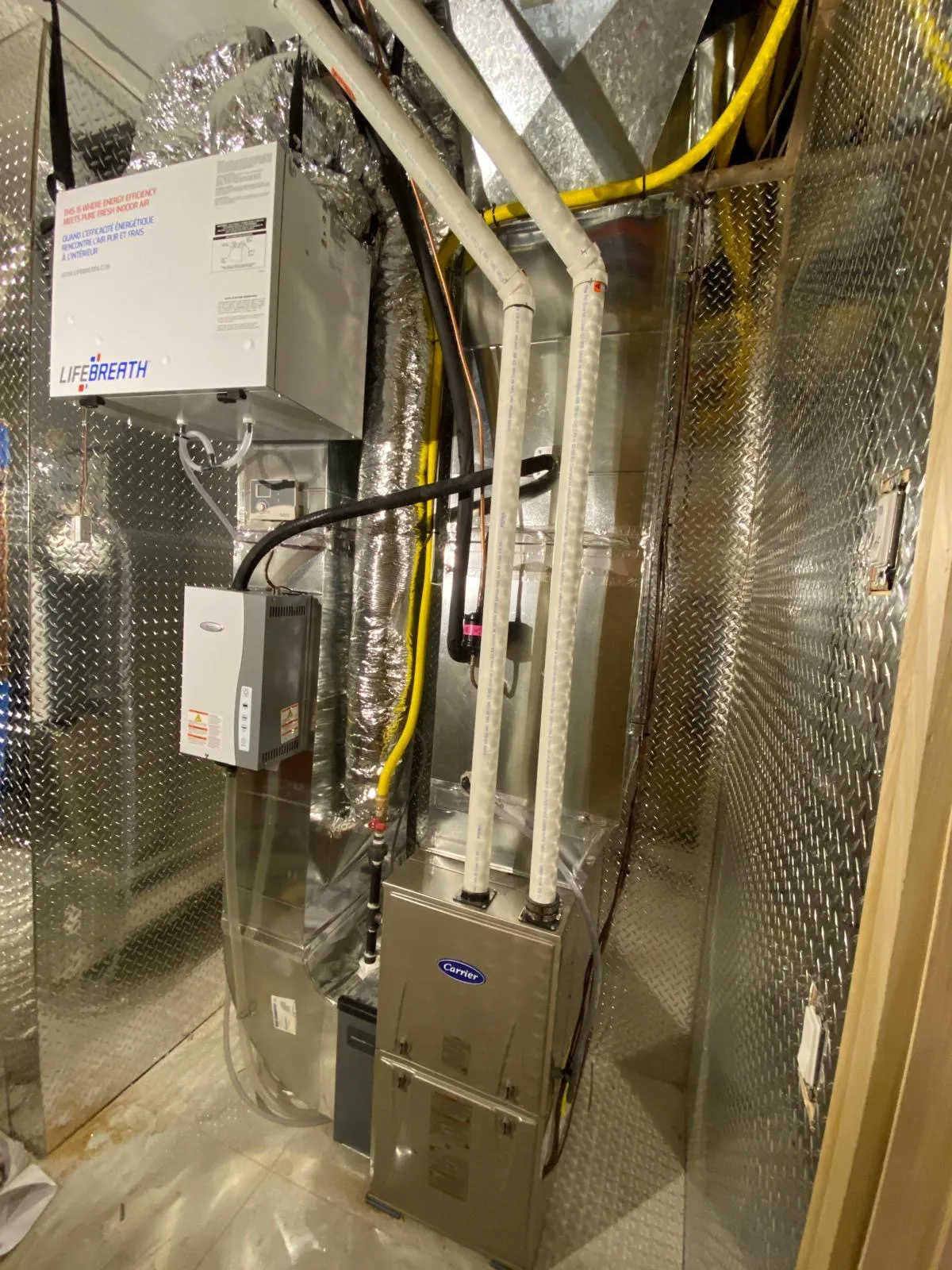
Your central HVAC system is the most powerful air cleaner in the house — it moves hundreds of cubic feet of air per minute through a single filter. The standard fibreglass “dust catcher” filter is essentially useless against smoke. What you want is a MERV 13 (or higher) pleated filter, properly sized for your blower.
| Filter rating | What it catches | Smoke performance | Notes for GTA homes |
|---|---|---|---|
| MERV 8 | Larger dust, pollen, pet dander | Poor | Common builder-grade default |
| MERV 11 | Finer dust, mould spores, some smoke | Fair | A reasonable everyday upgrade |
| MERV 13 | Most bacteria, PM2.5, wildfire smoke | Good | Recommended during smoke season |
| MERV 14–16 | Most fine particles | Very good | Often needs a deeper 4–5″ media cabinet |
| True HEPA | 99.97% at 0.3 microns | Excellent | Not practical in ductwork — use portable units |
A quick caution: just slamming a thicker, denser filter into a system designed for a flimsy one can choke airflow, ice up the A-coil, and stress the blower. If you’re stepping up from MERV 8 to MERV 13 mid-summer, change it on time, watch your supply temperatures, and consider a deeper 4″ or 5″ media cabinet — that’s a job we install routinely on GTA furnaces.
Add a portable HEPA in the room that matters most
Even with a great furnace filter, a portable HEPA air purifier in your main living area or bedroom moves the needle further. Look for one rated for the room’s square footage (CADR matters) and run it on a medium setting continuously, not just when smoke is visible.
A few practical tips:
- Place it away from walls and corners so it can pull a full circle of air.
- Don’t park it behind furniture or curtains.
- Keep bedroom doors closed at night with the purifier inside.
- Change or vacuum the pre-filter weekly during smoke events — it does a lot of the heavy lifting.
- Replace HEPA cartridges per the manufacturer, sooner if smoke is thick.
Run your HVAC the right way during a smoke event
Set your thermostat fan mode to “On” rather than “Auto” during a smoke event. That keeps the blower running constantly, pulling air through your MERV 13 filter even when the AC isn’t actively cooling. You’ll cycle more total air through the filter and even out hot and cold pockets in the house.
If you have a smart or variable-speed system, choose the recirculate or air-cleaning mode. Avoid economy or “fresh air” modes that intentionally pull outdoor air in. And remember: cooling and dehumidifying are part of comfort too — see our notes on summer humidity levels in GTA homes (coming soon at /journal/summer-humidity-levels-gta-homes/) for how to balance moisture without inviting outdoor air in.
What to do after the smoke clears
When AQHI drops back to normal, a quick reset keeps your system healthy:
- Swap the furnace filter — even a few smoky days can load it heavily.
- Run the bathroom and range fans briefly with windows cracked to flush stale indoor air.
- Vacuum supply and return registers and wipe horizontal surfaces with a damp microfibre cloth.
- Empty and rinse portable purifier pre-filters.
- Consider a professional duct cleaning if the home took on heavy smoke or smells lingering on fabrics.
Persistent smoke odour after a major event often points to soot settled in ductwork, on the A-coil, or in soft furnishings — that’s when a thorough mechanical clean pays off.
A smoke-season checklist for GTA homeowners
Use this as a quick reference when the AQHI climbs:
- Check the AQHI and weather forecast each morning.
- Close windows, doors, and fresh-air intakes.
- Switch thermostat fan to On, AC to recirculate.
- Confirm a clean MERV 13+ filter is installed.
- Run a portable HEPA in your main living space and bedrooms.
- Limit outdoor exercise, especially for kids and seniors.
- Watch carbon monoxide alarms if you’ve sealed the home tightly.
- Reset the system once the AQHI drops back to normal.
For a deeper look at how filtration, humidity, and ventilation work together year-round, our piece on indoor air quality in winter covers the cold-weather side of the same equation.
When to call Delson Air
If your filter slot is too shallow for a real MERV 13, your AC struggles to keep up when you switch to recirculate, or you’re not sure whether your HRV is pulling smoke into the house, that’s a job for a licensed tech. Delson Air has been keeping homes across the GTA — Toronto, Mississauga, Markham, Vaughan, Brampton, Richmond Hill, Oakville, and surrounding — comfortable and breathing easy for years. We’re licensed, insured, TSSA-licensed, and an Enbridge Authorized Contractor, so the work is done properly and safely.
Call us at (647) 467-9919 or book a visit and we’ll get your home set up before the next smoke advisory rolls in. Your Comfort, Our Priority.
FAQ
Common questions
Can my furnace filter actually stop wildfire smoke?
Should I run my air conditioner when it's smoky outside?
What's the difference between MERV 13 and HEPA?
Will a duct cleaning help after a smoky week?
Delson Air Team
Licensed, insured, TSSA-certified HVAC technicians serving the Greater Toronto Area.
Keep reading
More from the Journal
Summer Indoor Humidity Levels: Comfort Guide for GTA Homes
What ideal summer indoor humidity looks like for Toronto and GTA homes, why 30–50% is the comfort sweet spot, and how your AC and dehumidifier get you there.
Indoor Air Quality in Winter: Humidity, Dust & Stuffiness
Why GTA and Toronto homes feel dry, dusty, and stuffy every winter — and how to fix indoor air quality with humidity control, filtration, and fresh-air ventilation.
Heat Pump vs Furnace + AC: True 10-Year Cost of Ownership
Heat pump vs furnace + AC 10-year cost of ownership for GTA and Ontario homes: install, operating, maintenance, rebates, and lifetime totals compared in 2026.